When venturing into remote trails, mountains, or coastal routes, a reliable personal locator beacon (PLB) is a crucial safety tool. This guide reviews five top options designed for hikers and outdoor enthusiasts, focusing on GPS accuracy, global coverage, battery life, and ease of use. Each product below links to its Amazon listing for quick comparison and procurement.
| Product | Brand | Key Feature |
|---|---|---|
| ACR ResQLink 400 | ACR | GPS, 406 MHz distress signaling, no subscription |
| ACR ResQLink View | ACR | Buoyant design, GPS, SOS with return link service |
| ACR ResQLink 410 RLS | ACR | Return Link Service, long battery life, global coverage |
| Ocean Signal rescueME PLB1 | Ocean Signal | Compact, lifejacket attachment, long-life battery |
| ACR ResQLink 400 GPS Survival Kit | ACR | GPS, strobe light, loud whistle, quick rescue features |
ACR ResQLink 400 – SOS Personal Locator Beacon

The ACR ResQLink 400 provides satellite-based distress signaling with GPS positioning, designed for hikers, hunters, boaters, and outdoor adventurers. It operates without a subscription, making it a straightforward option for emergency readiness. Its 406 MHz distress signal is paired with a GPS fix to help rescuers locate you quickly, and LED strobing increases visibility in low-light environments.
ACR ResQLink View – GPS Personal Locator Beacon
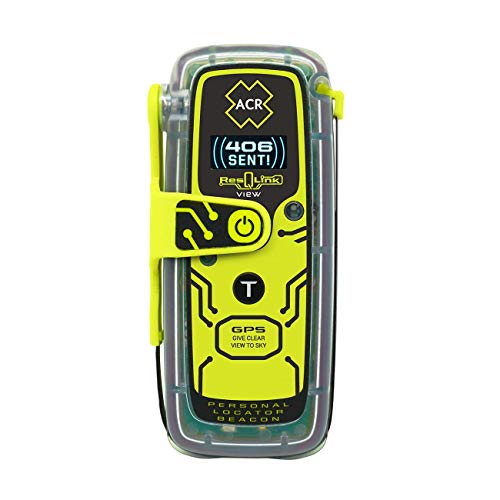
The ResQLink View adds buoyancy and a Return Link Service (RLS) to confirm that Search and Rescue has received the distress signal. It includes GPS positioning, a compact build, and versatile wearability with clips and lanyards for hikers, boaters, and campers. The device requires no subscription, and can test signals and GPS via optional services.
ACR ResQLink 410 RLS – GPS Personal Locator Beacon

The 410 RLS emphasizes the Return Link Service to alert the beacon owner when a distress signal is acknowledged by rescuers. It combines GPS, Galileo GNSS, and MEOSAR compatibility for global coverage, a crucial feature for international hikes or multi-country trips. It offers long operational life with no ongoing subscription requirements.
Ocean Signal rescueME PLB1

The rescueME PLB1 is designed for one-handed operation and is notably compact, making it easy to attach to life jackets or belts. It offers reliable operation for over 24 hours and is waterproof for marine use. The PLB1 remains a simple, dependable option for hikers near water or those who prioritize minimal bulk in their kit.
ACR ResQLink 400 GPS Survival Kit

This survival kit combines the ResQLink 400 with supplemental signaling tools, including a bright C-Strobe H2O rescue light and a Res-Q whistle. The combination supports rapid signaling, visibility, and audible attention in emergencies, alongside GPS positioning for accurate rescue coordination. The kit is designed for compact carrying in daypacks and larger outdoor packs alike.
Buying Guide
- Global coverage and satellite support: Look for PLBs that use 406 MHz distress signals with GPS and, ideally, MEOSAR compatibility for faster localization by rescue services.
- GPS and location accuracy: GPS-enabled beacons provide rescuers with precise coordinates. Some models also support Return Link Service (RLS) to confirm signal reception.
- Buoyancy and wearability: Buoyant or life-jacket-compatible designs are beneficial for water-adjacent activities. Consider clips, lanyards, and waterproof ratings (IPX) for rugged environments.
- Battery life and reliability: Long-lasting batteries ensure functionality during extended trips. Some units include dual power options or long standby modes.
- Subscription considerations: Most PLBs operate without ongoing fees, but optional services (e.g., dedicated testing or messaging) may add capability. Assess if you need SMS/text alerts to trusted contacts.
- Portability and ruggedness: For hikers, a compact, lightweight beacon is easier to carry without compromising durability or ease of use in emergencies.
- Additional signaling tools: Some kits include strobes, whistles, or lights to supplement beacon signaling for rescuers, which can be advantageous in certain conditions.
- Environment compatibility: If water exposure or marine use is likely, ensure the device is waterproof and that mounting options are suitable for life jackets or backpacks.
In choosing a hiking emergency beacon, prioritize models with GPS accuracy, global coverage, easy one-handed operation, and long battery life. For multi-day trips or activities near water, consider buoyant designs and kits that include signaling accessories to enhance visibility and audible alerts. All listed products provide subscription-free operation, which can simplify preparedness for casual and serious outdoor enthusiasts alike.