Choosing a cycling computer with GPS can boost training, navigation, and overall ride planning. This guide highlights five top options, detailing key features such as GPS accuracy, battery life, waterproofing, and data analytics. Whether you ride road, mountain, or gravel, these devices provide reliable performance and clear data visualization to help you train smarter and ride farther.
| Product | Brand | Key Strength | Great For |
|---|---|---|---|
| Garmin Edge 540 | Garmin | Advanced navigation and adaptive coaching | Performance-focused riders seeking coaching insights |
| COROS DURA Solar | COROS | Ultra-long battery with solar assist | Long tours and bikepacking |
| iGPSPORT BSC300T | iGPSPORT | Touchscreen with offline navigation | Road, MTB, and E-bike riders needing quick touch control |
| COOSPO CS600 | COOSPO | Color touchscreen with built-in navigation | Riders who value clear maps and simple route loading |
| COOSPO Bike Computer (GPS) | COOSPO | Versatile GPS with ANT+/Bluetooth | Data-rich rides with sensor integration |
Below is an overview of five strong GPS cycling computers, each offering distinctive advantages. Read on to compare interfaces, battery life, and navigation features to match your riding style.
Garmin Edge 540: Compact GPS Power

The Garmin Edge 540 blends precise GPS navigation with actionable training insights. It offers advanced navigation, planning, and performance tracking, helping riders stay on course and optimize workouts. Battery life supports long sessions, with up to 26 hours in demanding use and up to 42 hours in saver mode. Users can view on-screen workouts and receive coaching prompts adapted to training load and recovery when paired with compatible sensors.
Navigation and performance data are presented in a clear, intuitive layout. The device supports smart connectivity, enabling seamless data transfer to companion apps and services. Its combination of responsive navigation, robust data, and reliable battery performance makes it a strong choice for riders who value coaching feedback and dependable routing on varied courses.
COROS DURA Solar GPS Bike Computer

COROS DURA stands out with an exceptional 120-hour GPS battery life on a single charge, ideal for extended trips. Solar charging adds extra ride time in direct sun, reducing the need for frequent recharges during multi-day events. The 2.7-inch MIP color touchscreen supports fast, easy navigation, and the device is designed for quick data access while riding. It also supports Strava, Ride with GPS, and Komoot for route planning and sharing.
With dual-frequency GPS and a streamlined interface, DURA provides reliable tracking and turning navigation. The combination of long battery life and solar-assisted charging makes it a practical option for riders who embark on long distances or bikepacking excursions where charging opportunities are limited.
iGPSPORT BSC300T: Touchscreen Navigation
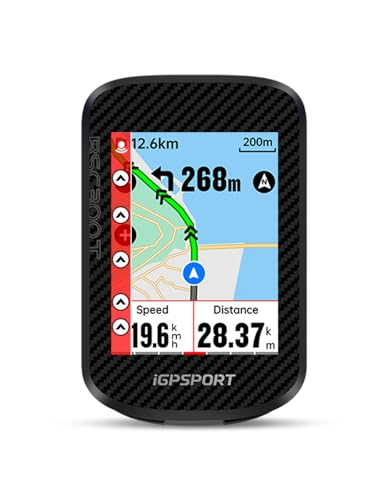
The BSC300T combines a 2.4-inch touchscreen with a 6-button interface, offering flexible control on the go. It supports multiple bike types, including road, mountain, and E-bike, and can display power level data when available. With GPS, Beidou, GLONASS, GALILEO, and QZSS coverage, positioning is fast and reliable, making it a practical choice for riders who want quick access to navigation and ride data without relying on a phone.
In addition to offline navigation, the device supports route viewing and on-device alerts, including off-course warnings. The touch and button combination aims to deliver a balance between quick, intuitive interactions and precise data access, especially in variable riding conditions.
COOSPO CS600 Color Touchscreen GPS Bike Computer

The COOSPO CS600 offers a 2.4-inch color touchscreen with auto backlight for day and night visibility. It uses GPS and GLONASS for fast satellite acquisition and reliable tracking of speed, distance, and route data. Built-in route navigation helps riders follow planned paths, with breadcrumb-style mapping to minimize wrong turns. It also integrates with Bluetooth and ANT+ for sensor compatibility, and the display is designed for glove-friendly interaction.
This model emphasizes ease of route exploration and data visualization, making it suitable for riders who want straightforward navigation alongside rich ride metrics. The combination of a responsive touchscreen and clear on-screen maps enables quick decisions during rides.
COOSPO Bike Computer GPS with ANT+/Bluetooth

This COOSPO model emphasizes sensor integration, supporting ANT+ and Bluetooth for heart rate, speed, cadence, and power meter connections. It features reliable GPS positioning with a 2.4-inch LCD screen for clear data readouts. The device works with the COOSPO Ride app to quickly connect and configure, load routes, track rides, and manage firmware updates.
With compatibility for multiple sensors and a straightforward app setup, it offers a balanced option for riders who want a data-rich experience without complex setup. The device is designed to be robust in daily use and in varying weather conditions, thanks to IP-rated protection.
Buying Guide: Key Purchase Considerations
- GPS accuracy and satellite support: Look for multi-band or multi-constellation support (GPS, GLONASS, Galileo, Beidou, QZSS) for faster positioning and stable data in challenging environments.
- Battery life and charging options: Long rides require devices with extended GPS runtimes. Solar charging can extend life for bikes on extended trips.
- Display and interface: Consider screen size, color vs. monochrome, touch vs. button controls, and glove compatibility for conditions on the road.
- Navigation and mapping: Assess whether on-device maps, breadcrumb trails, route loading from apps, and turn-by-turn guidance match your preferred riding style.
- Sensor compatibility: Ensure compatibility with heart rate monitors, cadence sensors, power meters, and bike radar when you rely on precise training data.
- Durability and water resistance: IP ratings and rugged construction help protect devices from rain, mud, and splashes typical of outdoor riding.
- Data ecosystem: Check how easily you can transfer rides to Strava, Komoot, Ride with GPS, or other platforms, and how well the device integrates with third-party apps.
- Learning curve and usability: A device with intuitive navigation and quick, readable data fields reduces cognitive load during rides.
This selection emphasizes devices with reliable GPS, practical navigation features, and strong data capabilities across different riding styles. Riders should weigh battery life, screen readability, and ecosystem compatibility when choosing a model that best aligns with training goals and cycling routines.